
Malheur Projected Versus Actual Release
Oregon Offender Search uses the exact label Earliest Release Date. It is a prospective field beside the person’s current profile, status, location or caseload, and institution-admission details. It is not a promise, a gate-out timestamp, or a historical discharge date. The displayed value may change as the sentence computation changes.
A county-jail detainee awaiting trial usually has no fixed projected release date. A court may order release, set conditions, change security, or resolve the case, yet jail processing and another hold can still affect physical departure. A sentenced Malheur County jail inmate has a different credit system from a person serving an Oregon DOC term. Mixing those rules creates a false date.
Even an accurate release from one sentence may lead straight to another custodian. A detainer is a hold or request from another authority. Transfer to another county, Oregon DOC, federal custody, or immigration custody is not release into the community. Ask for the release disposition and receiving agency.
Find a Malheur Projected Release Date
Begin with the last known custodian. Snake River Correctional Institution is an Oregon DOC prison, while the Malheur County Correctional Facility is the county jail. Geography does not merge their records. Oregon OOS is appropriate for a state-prison sentence or current Community Corrections supervision. MCSO and the circuit court control the local jail and court sources.
- Identify whether the sentence belongs to the county jail, Oregon DOC, or another authority.
- Retrieve the original and amended judgments, offense date, counts, and concurrent or consecutive terms.
- For DOC custody, open Oregon Offender Search, search by SID when possible, and select the linked SID.
- Read Status, Location, Caseload, Institution Admission Date, and Earliest Release Date together. Then note the docket, county, crime, sentence type, begin date, and termination date.
- For a county term, ask MCSO for its credited-time computation under the county-jail statute.
- Check for another case, warrant, detainer, transfer, amended judgment, or Board action.
- Confirm the completed event with an agency release or discharge record or a saved VISOR alert.
The broader search route for a named person appears on the Malheur County released-inmate home page. It covers the county record, court disposition, state DOC, and other authorities. A no-hit in OOS does not prove release because OOS is limited to people in current DOC custody or local Community Corrections.
Note: Record the date of each lookup because custody, caseload, credits, and projected release fields can change.
Malheur DOC Earliest Release Field
The DOC’s official example record shows how the Earliest Release Date appears with identity, status, caseload, location, and sentence data.
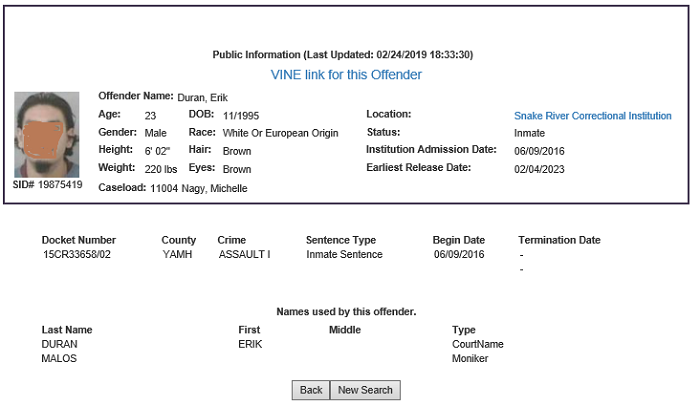
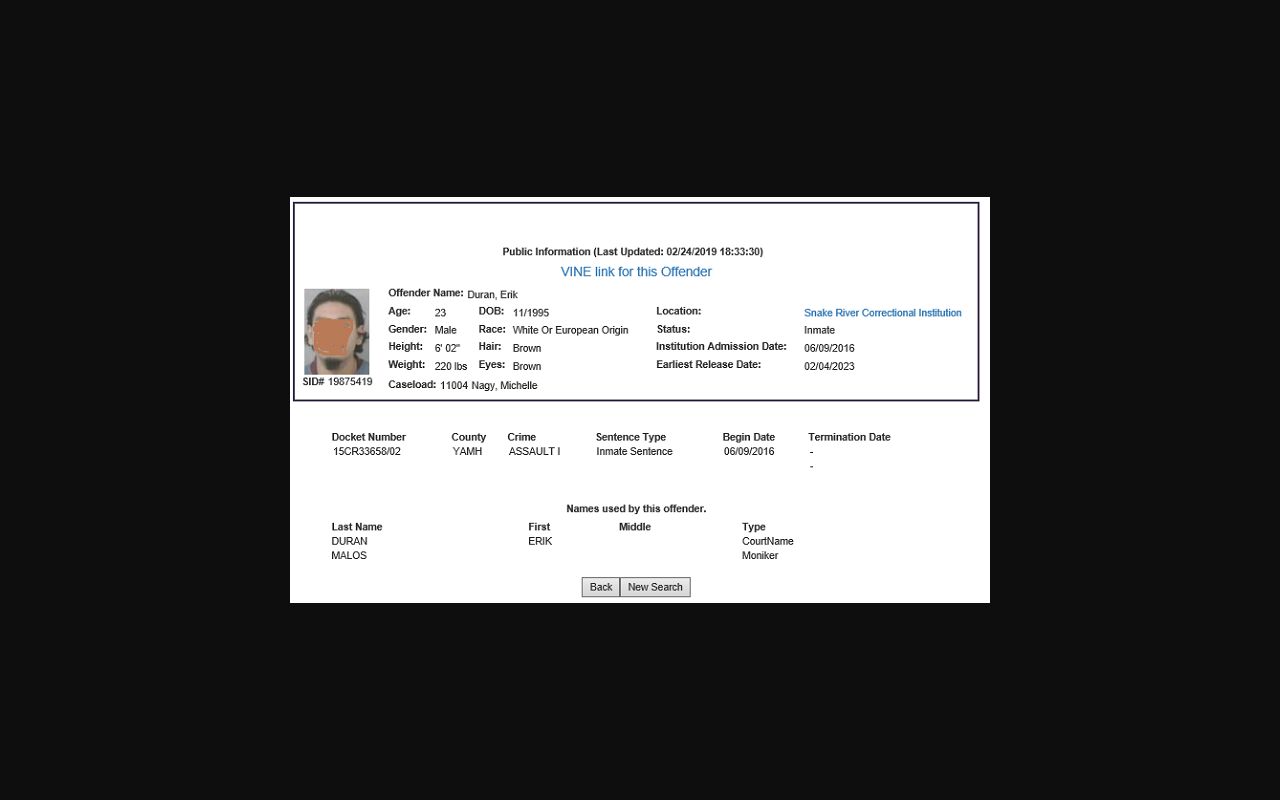
The surrounding fields are essential. An institution location usually points to prison custody, while a Community Corrections caseload can mean the person has left prison but remains supervised. The date does not establish an actual release or full discharge.
| OOS field | Why it matters |
|---|---|
| Status | Places the date in current custody or supervision context |
| Location and Caseload | Distinguish an institution from Community Corrections |
| Institution Admission Date | Provides one timing input, not the whole computation |
| Earliest Release Date | Shows the current prospective DOC value |
| Docket and county | Point to the controlling court judgment |
| Begin and termination dates | Help reconcile individual sentence counts |
OOS says its information is periodically updated and unofficial. For an official explanation, use the Oregon DOC Public Records Center and request the sentence-computation and custody-status history. Include the full name, SID, date range, institution, and court case when known.
Oregon Prison Earned-Time Rules
ORS 421.121 governs reductions for eligible Oregon DOC terms. For covered felony terms tied to crimes committed on or after November 1, 1989, credit may be awarded for proper institutional conduct and participation in adult basic skills. The maximum is 20 percent of the total DOC term. Credit may be awarded, retracted, or restored under DOC rules.
The maximum is not automatic. The statute excludes sentences imposed under specified provisions, including ORS 137.635, 137.700, 137.707, 163.105, 163.107, and 163.115. It also does not permit the credit to cut actual prison confinement below six months. Offense date, conduct, program participation, judgment, and statutory eligibility all matter.
Oregon does not have a universal rule that every person serves 85 percent. An otherwise eligible term may be reduced by up to 20 percent, which is sometimes described as an 80-percent floor, but only after checking the controlling sentence. ORS 137.700, commonly associated with Measure 11 minimums, bars the ORS 421.121 reduction for covered minimum terms. Read the actual judgment and current statute.
Malheur County Jail Credit Schedule
A definite local jail sentence uses a separate law. ORS 169.110 places rule-compliance credit within the sheriff or custodian’s discretion. The statutory schedule varies with the length of the term. It must not be replaced with the DOC 20-percent formula.
| Definite county term | Possible schedule |
|---|---|
| 10 through 30 days | One day per ten days |
| More than 30 through 90 days | Three days per 30-day period |
| More than 90 through 180 days | Four days per 30-day period |
| More than 180 through 270 days | Five days per 30-day period |
| More than 270 days | Six days per 30-day period |
For a Malheur County calculation, obtain the definite term, judgment credit, start point, concurrent or consecutive structure, and sheriff computation. Alternative-sentencing-facility deductions depend on county authorization. Even sound arithmetic cannot rule out a second case, warrant, detainer, or transfer.
Why Malheur Release Dates Change
A projected release value draws from many legal and administrative inputs. One change can move the result. Some events affect the sentence itself; others change where the person goes when one authority releases them.
| Factor | Possible effect | Record to check |
|---|---|---|
| Earned-time award or retraction | Moves an eligible DOC date | DOC computation history |
| Institutional misconduct | May retract credit or support Board postponement | DOC or Board order |
| Amended or appellate judgment | Changes counts, terms, or legal basis | Court judgment |
| Concurrent or consecutive structure | Changes how multiple terms combine | Judgment and calculation |
| Detainer, warrant, or new case | May cause transfer or continued custody | Releasing and receiving agencies |
| Board action | May set, affirm, defer, or postpone a date in eligible cases | Board Action Form |
| Escape or inoperative time | May stop time from counting | Official computation |
The Board does not control most modern determinate release dates. Its authority remains important for limited legacy, indeterminate, murder-review, dangerous-offender, and related sentence categories. A hearing calendar only shows scheduling. Retrieve the Board Action Form to learn the result.
Board hearing outcomes are more detailed than a simple grant or denial. A Prison Term hearing may set a projected parole release date or decline to set one. An Exit Interview may affirm or defer the date. A Parole Postponement may extend it after serious institutional misconduct, while Future Disposition after revocation can determine re-release or more imprisonment. Those actions must be read from the final Board record.
Note: A release date from one sentence never proves that every local, state, federal, or immigration hold has ended.
Confirm a Malheur Release Event
The channel sweep yields a different confirmation path for each custody type. For Malheur County jail custody, call the jail at 541-473-5510 and request the existing booking and release record when a precise timestamp is needed. The court judgment explains legal authority but may precede processing. Ask for the destination if staff report a transfer.
A useful MCSO request to Sheriff Travis Johnson through the Malheur County records policy names the person, booking or local number if known, confinement dates, admission timestamp, physical release timestamp, release authority or disposition, and receiving agency. The county need not create a custom date computation or answer a research question. It can provide an existing record, point to a public source, assert an exemption, or say that it is not the custodian. A sheriff computation under ORS 169.110 is the relevant local document when earned credit affects a definite jail term.
For Oregon DOC, request custody-status history and the actual release or discharge date through the official public-record channel. A VISOR release alert can preserve a reported custody change, but it does not decide whether supervision continues or another agency assumed custody. Oregon’s current service is VISOR, despite the familiar VINELink name; registration and limits are detailed on the VINELink Inmate Search page.
Malheur Circuit Court records provide another durable layer. The Register of Actions, original and amended judgments, sentence terms, custody credit, and later discharge entries can explain the legal basis for a date. They do not establish the physical minute of release. Processing time and an outside hold can intervene after a court order, so pair the judgment with the jail or DOC release record.
The assigned DOC public-record page shows the official fallback when the OOS display does not answer a historical or computation question.
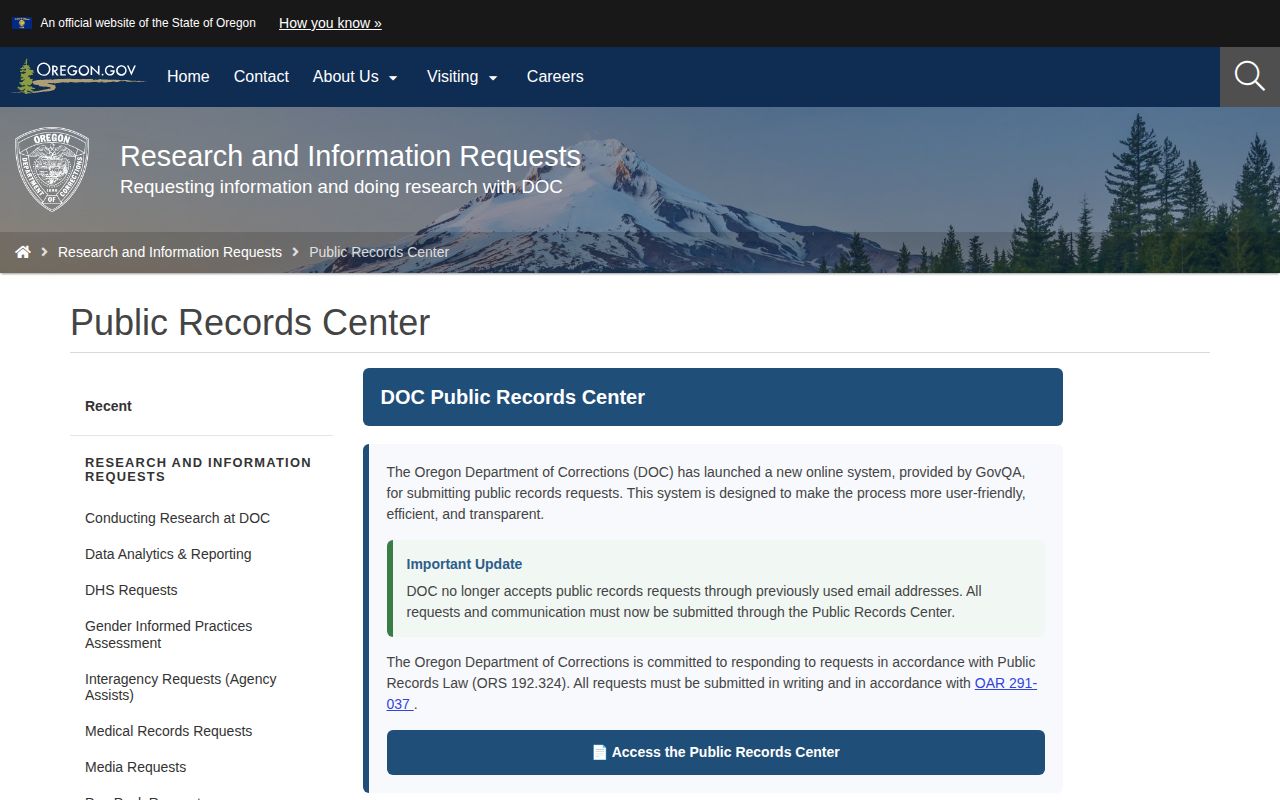
A focused request should seek the actual release or discharge date, release authority, receiving or supervising agency, and sentence-computation history rather than asking DOC to create a new estimate.
Reconcile Malheur Sentence Dates
A reliable calculation starts with the judgment, not the public projected field. Confirm the offense date because the governing statute can depend on it. Read every count and note whether terms run at the same time or one after another. Include credited jail time, any amended or appellate judgment, and the sentence begin date. Then identify which credit law applies.
For a DOC sentence, compare the judgment with OOS and request the official computation when the numbers do not align. Determine whether ORS 421.121 permits earned time or whether an exclusion, including a covered ORS 137.700 minimum, blocks that reduction. Program rules and discipline can alter awarded credit. Do not subtract 20 percent automatically.
For a Malheur County jail sentence, use the graduated ORS 169.110 schedule and the sheriff’s actual award. For a Board case, add the Board order rather than guessing from the public calendar. Finally, ask whether a warrant, detainer, new case, or transport order changes the destination at release. This sequence separates a mathematical estimate from confirmed departure.
- Concurrent
- Sentence terms that run at the same time.
- Consecutive
- Sentence terms that run one after another.
- Earned time
- A lawful reduction awarded under the governing statute and rules.
- Actual release
- The completed departure or transfer recorded by the releasing authority.